Our Blog

Same-Day
Response Available
Factory
Certified OEM Parts
All Models
Supported
100%
Satisfaction Guaranteed

Premium Service for Premium Appliances

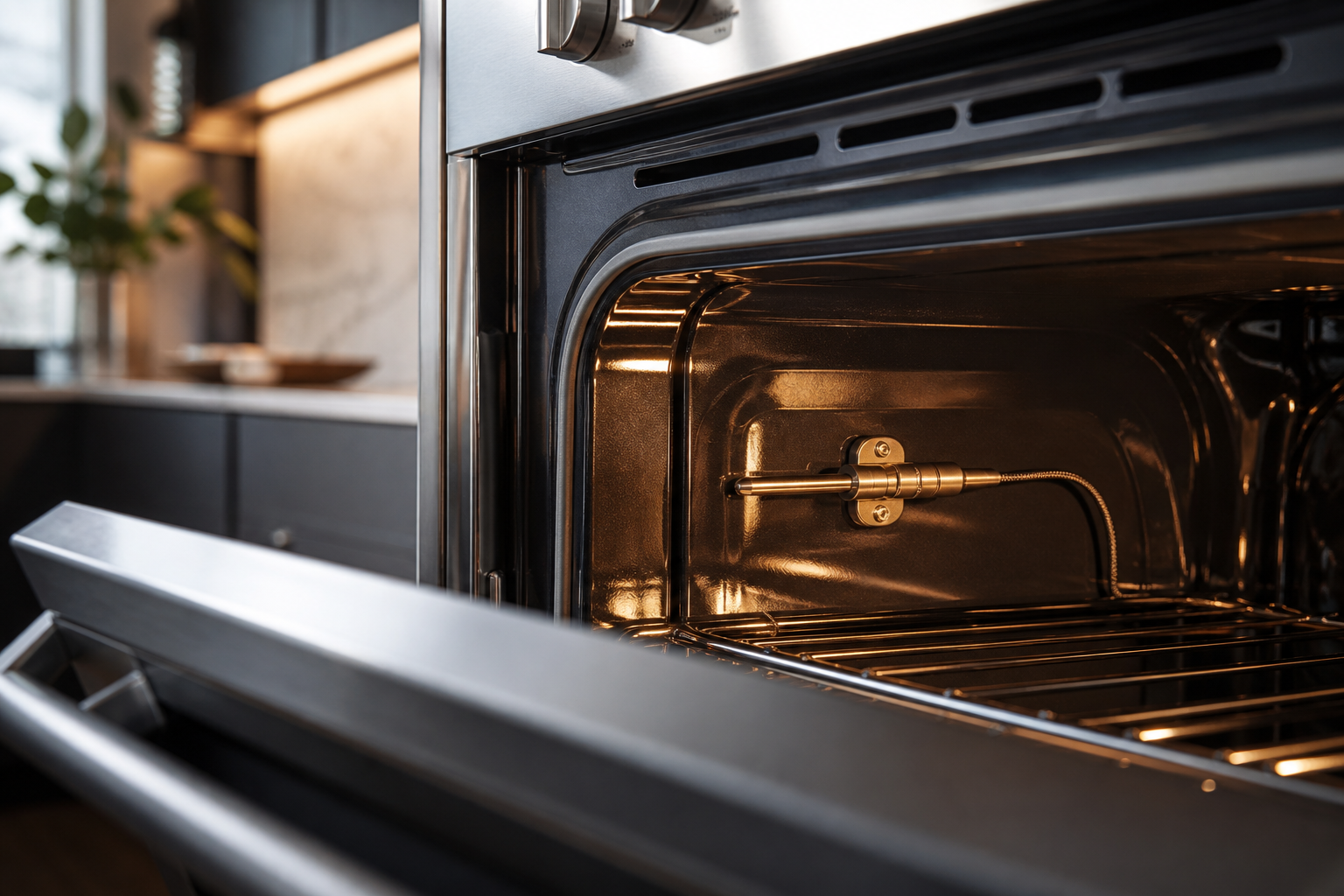
The Resistance Temperature Detector — universally known as the RTD — is the high-precision sensing element that serves as the electronic "eye" inside your La Cornue oven. Unlike a simpler thermocouple, which generates a small voltage proportional to temperature, an RTD operates on a fundamentally different and more accurate principle: it contains a coil of pure platinum wire whose electrical resistance changes in a highly predictable and linear manner with temperature. The oven's control board applies a small reference current to this platinum element and measures the resulting resistance to determine the exact vault temperature with a precision of ±0.5°F. When this sensor fails or develops electrical "noise," your range will typically display an F3 or F4 series error code and disable the oven heaters as a safety precaution.

Before recommending a replacement, we perform a complete diagnostic of the entire RTD signal circuit. The most common cause of RTD-related error codes is not a failed sensor — it is a loose terminal connection or a section of the two-wire signal harness that has been damaged by the intense thermal cycling inside the range. We use a precision four-wire ohmmeter to test the resistance of the probe at multiple temperature points and compare the measured values against the published resistance-temperature curve for a genuine La Cornue RTD. We also perform a signal noise analysis using an oscilloscope to detect electrical interference from nearby high-current components that can corrupt the RTD signal and trigger false error codes.

If the sensor itself has failed, we replace it exclusively with genuine La Cornue RTD probes. The selection of an RTD for a oven is not a generic decision — the probe must be matched to the specific platinum element grade (PT100 or PT1000) and dimensional specifications of your model. The probe's insertion depth and its position within the airflow path are also critical: a probe that is too short, or inserted at the wrong angle, will read the temperature of the oven wall rather than the circulating air mass. We verify the correct positioning after installation with a live thermal comparison.

We also test for the failure mode known as "thermal drift" — a subtle degradation where the sensor still produces readings within the normal resistance range but those readings become progressively less accurate as the oven temperature rises. This mode of failure is insidious because it does not trigger an error code; it simply causes your baking results to become inconsistent in ways that are difficult to trace. By comparing the sensor's resistance curve at high temperature against a factory reference, we identify and replace these aging sensors before they compromise your kitchen's performance.

What’s Covered

Every point in our service scope — nothing overlooked, nothing outsourced.

Four-Wire Precision Ohm Resistance Mapping: We measure the RTD's resistance at ambient, mid-range, and high-temperature set points using a four-wire Kelvin connection that eliminates lead-resistance errors, then compare the results against the published PT100/PT1000 resistance-temperature curve.

Oscilloscope Signal Noise Analysis: The RTD signal wire is connected to a digital oscilloscope to detect high-frequency electrical noise from nearby relay switches or power wiring that can cause the control board to misread a perfectly functional sensor as faulty.

Full Harness Continuity & Insulation Test: Every inch of the two-conductor RTD signal harness is tested for continuity, conductor-to-conductor shorts, and insulation breakdown to ground — failures that mimic RTD failure but require harness replacement, not probe replacement.

Factory-Grade Probe Positioning Verification: After replacement, we use a secondary reference probe to confirm that the new RTD reads within ±2°F of the true oven air temperature at 350°F, verifying correct insertion depth and airflow path positioning.

Thermal Drift Detection Test: We compare the sensor's resistance readings at 250°F, 350°F, and 450°F against factory reference values to detect the gradual calibration drift that produces inconsistent baking results without triggering an error code.

Control Board Error Code Clearing & Verification: After all repairs are confirmed, we clear the stored fault codes from the control board's non-volatile memory and run a supervised heat cycle to confirm no new codes are generated before the service is closed.

The La Cornue Standard

  • Ohm Resistance Mapping
  • Harness Integrity Check
  • Logic Board Signal Audit
  • Factory Probe Replacement
  • Error Code Clearing
RTD Sensor Replacement
Available Now

Ready to Help

Factory Certified Specialists

Serving luxury kitchens with genuine OEM parts and factory-protocol repairs.

Schedule Visit Now Book Online Instead

Fast Response Coverage

Chicago • NYC • LA • SF
Miami • Houston • Dallas • Boston

How It Works

Our Service Process

Four clear steps from first contact to a fully verified, operational appliance.

1

Book Online or Call

Schedule in minutes with our streamlined booking system — or call for a same-day appointment.

2

Expert Diagnosis

A factory-trained technician arrives on time and performs a thorough system-wide assessment of your appliance.

3

Precision Repair

We use only genuine La Cornue factory parts and follow manufacturer protocols for every fix — no shortcuts.

4

Verified Performance

A full operational test is conducted before our technician departs — you cook, we confirm it's perfect.

Fast Response

Book Your RTD Sensor Replacement Today

Fill out the form below and a factory-certified La Cornue specialist will confirm your appointment.